 By Ethan Brooks
If you are looking for a qlife automatic pet feeder, you probably want one thing above all: meals that arrive on time, in the right portion, even when you are at work, running errands or traveling for a weekend. A good automatic feeder handles that job quietly, but the models differ more than their box art suggests. Some hold a few cups, others hold enough for a week. Some have a single bowl, others split meals across the day. Some connect to an app, while others rely on a simple dial and a clock. This guide narrows the field to five options and explains how we weighed them. Our selection is based on manufacturer specifications, brand track record, and the patterns that owners tend to describe in their feedback, such as jams, timer reliability, and how easy the portions are to adjust. We have not tested these units ourselves, so treat the specs as what the makers publish and check them against the listing before buying.
Our Top Picks
Quick Comparison
| Product | Best for | Key feature |
|---|---|---|
| qlife Automatic Pet Feeder (standard dry food model) | Single cat or small dog on a fixed schedule | Programmable meal times with portion control |
| qlife Smart WiFi Pet Feeder | Owners who want to adjust meals from a phone | App-based scheduling and remote monitoring |
| qlife Large Capacity Pet Feeder | Large dogs or multi-pet homes | Extended food storage for several days |
| qlife Dual Bowl Pet Feeder | Households with two pets that eat at different times | Separate compartments with individual timers |
| qlife Compact Pet Feeder | Small apartments and light users | Small footprint and simple setup |
qlife Automatic Pet Feeder (Standard Dry Food Model)
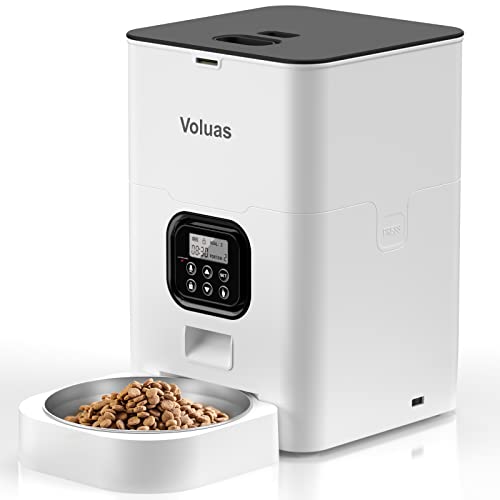
This is the most straightforward choice for a household with one cat or a small dog that eats two or three set meals a day. It suits owners who want a clock, a portion dial and a sealed food chamber without paying for connectivity they will not use.
Key specs
- Designed for dry kibble
- Programmable meal times, typically several per day
- Adjustable portion size per meal
- Single food bowl with a lidded food reservoir
Pros
- Simple programming that most owners can complete in a few minutes
- No app or Wi-Fi requirement, so it works in any location
- Lidded storage helps keep kibble fresh between meals
Cons
- Limited food capacity compared with larger models
- No remote monitoring, so you cannot see whether a meal was dispensed
qlife Smart WiFi Pet Feeder
Best for owners who travel, work long hours, or want to change the feeding schedule without walking to the machine. You will need a reliable home Wi-Fi network and a phone to get full value from it.
Key specs
- Wi-Fi connectivity with a companion smartphone app
- Scheduled and manual feeding from the app
- Adjustable portion sizes stored per meal
- Designed for dry food
Pros
- Change meal times or portions from anywhere
- Useful for households where more than one person handles feeding
- Feeding history in the app helps spot missed or extra meals
Cons
- Depends on a steady Wi-Fi connection; owners often report occasional sync delays
- Requires a phone and app setup, which adds a step for less tech-minded users
qlife Large Capacity Pet Feeder
Designed for large dogs or homes with more than one pet, where a small hopper would need refilling every day. It also suits owners who buy food in bulk and want fewer refills.
Key specs
- Larger food reservoir than standard models
- Programmable meal times and portion control
- Designed for dry kibble
- Wide bowl for larger dogs
Pros
- Fewer refills for multi-day coverage
- Bowl size suits bigger dogs more comfortably
- Good for bulk kibble buyers
Cons
- Takes more counter or floor space than compact models
- Heavier when full, which can make moving it more awkward
qlife Dual Bowl Pet Feeder
Suited to households with two animals that have different diets or feeding schedules. Separate compartments let each pet receive its own portion at its own time, which is useful for a senior cat on a prescription diet alongside a young dog.
Key specs
- Two separate food compartments
- Individual timers for each compartment
- Separate portion settings
- Designed for dry food
Pros
- Keeps different diets fully separated
- Each pet gets a dedicated schedule
- Reduces food stealing between pets
Cons
- Each compartment holds less food than a single large hopper
- Setup takes longer because each side is programmed separately
qlife Compact Pet Feeder
A good fit for small apartments, dorm rooms and light users who only need one or two meals a day for a small cat or toy breed. Its small footprint makes placement easy on a kitchen counter.
Key specs
- Compact body and small food reservoir
- Basic programmable meal times
- Adjustable portion size
- Designed for dry kibble
Pros
- Fits in tight spaces
- Quick to set up and clean
- Straightforward controls
Cons
- Small capacity means more frequent refills
- Not ideal for large dogs or multi-meal households
Buying Guide
Selection Criteria
When comparing any automatic feeder, start with the animal, not the gadget. Weight, appetite, number of pets and how many meals per day all shape the right capacity and bowl design. Next, consider how you will program the unit. A dial and clock are fine for a routine that rarely changes, while an app helps if your schedule shifts often. Finally, look at how the feeder handles food storage, since humidity and pests are common concerns with dry kibble.
Important Features
- Programmable meal times: Confirm how many meals per day the timer supports and whether each meal can have its own portion.
- Portion control: Check the smallest and largest portion increments. Fine increments matter for cats and small dogs.
- Food reservoir capacity: Compare the hopper size against your pet’s daily intake to estimate refill frequency.
- Lid and seal: A tight lid reduces odor and keeps moisture and pests out.
- Power backup: Some units keep their schedule through a power outage with batteries, while others reset. Check the manufacturer’s note.
- Cleaning access: Look for removable food chambers and bowls that go in the dishwasher or rinse easily.
Specs to Check
| Spec | Why it matters | What to look for |
|---|---|---|
| Food capacity | Determines refill frequency | Enough for 2 to 3 days for a single pet, more for multi-pet homes |
| Meals per day | Matches your feeding routine | At least as many slots as your vet recommends |
| Portion increment | Controls accuracy | Small steps for cats and small dogs |
| Connectivity | Controls remote management | Wi-Fi only if you will actually use the app |
| Power source | Keeps schedule during outages | Battery backup if outages are common in your area |
Choosing by Need
If you have one cat and a steady routine, the standard model is usually enough. If you travel often or change schedules, the smart WiFi version earns its place. For large dogs or several pets, look at the large capacity model. For two pets with different diets, the dual bowl design solves the problem directly. Choose the compact unit when space or household size is the main limit.
Things to Watch Out For
- Dry food only: most automatic feeders are designed for kibble. Wet food spoils quickly and needs a different solution.
- Jams: kibble that is too large, oily or clumped can jam the dispenser. Check the size guidance in the manual.
- Overfeeding: an automatic feeder does not know how much your pet has already eaten elsewhere. Work out daily calories with your vet.
- Pets that learn the machine: some animals learn to paw or push at the feeder. Place it on a stable surface.
For medical diets or specific calorie targets, consult your veterinarian before setting portions.
FAQ
Can a qlife automatic pet feeder handle wet food?
Most automatic feeders in this category are designed for dry kibble. Wet food can spoil at room temperature and may clog the dispenser. Check the manufacturer’s listing for supported food types before buying.
How many meals can I schedule each day?
The number of programmable meals varies by model and is listed in the specifications. Confirm the count in the product listing or manual, since it is the main factor for multi-meal routines.
Does the feeder keep its schedule during a power outage?
This depends on the model. Some units use battery backup to retain their settings, while others need to be reset after power returns. Look for the backup feature in the specs and check the user manual.
Do I need Wi-Fi to use the smart version?
Yes. The smart WiFi model relies on a home network and the companion app to schedule and monitor feedings. The standard model works without a network connection.
How often should I clean the feeder?
Owners generally wipe the bowl daily and clean the food chamber at least weekly, especially in humid climates. Follow the cleaning instructions in your manual, since some parts are not dishwasher safe.
Can two pets share one feeder?
A single-bowl model can work if pets eat at different times, but it is risky for pets that eat fast or guard food. The dual bowl design is better for separate diets or schedules.
How do I avoid overfeeding with an automatic feeder?
Calculate your pet’s daily calorie needs with your veterinarian, then set portions and meal times to match. Check body condition regularly and adjust with professional guidance.
Conclusion
For most single-pet households, the standard qlife automatic pet feeder covers the basics with simple controls and no network requirement. Owners who want to manage meals remotely should consider the smart WiFi model, while large dogs and multi-pet homes will benefit from the large capacity design. Two pets on different diets point to the dual bowl version, and small spaces suit the compact option. Match the capacity, meal count and connectivity to your routine, check the manufacturer’s specs, and confirm the details with your veterinarian for any special diet.
Related reading
- Wopet Automatic Pet Feeder Setup: 7 Best Picks Compared (2026)
- Wopet Automatic Pet Feeder Manual: Setup, Programming and Troubleshooting Guide
- Wopet Automatic Pet Feeder Manual Pdf: Setup and Program Steps
- Voluas Automatic Pet Feeder Setup: 6 Best Picks Compared (2026)
- Voluas Automatic Pet Feeder Review: Features and Performance
- Voluas Automatic Pet Feeder Portion Size Chart: How to Set Portions (2026)
About Ethan Brooks
Ethan Brooks is part of our editorial team and reviews and edits our everyday pet gear guides, checking product details against manufacturer specifications and owner feedback.