 By Ethan Brooks
An arf pets automatic pet feeder portion sizes chart is only useful if you know how to read it, so this guide walks you through converting your pet’s weight and activity level into a daily amount, splitting that amount into meals, and entering it into the feeder without guessing. By the end, you will have a working portion number, a meal schedule and a quick way to check that the feeder is dispensing what you intended.
Because automatic feeders measure food by volume (cups, grams or portion counts) rather than by calories, you still need to start from a sound daily target. The steps below show how to get there, along with the factors that shift portions up or down.
Shopping for one? See our guide: 8 Best Voluas Automatic Pet Feeder Portion Size Options Compared.
Why a Portion Chart Is a Starting Point, Not a Final Answer
Feeding charts printed on bags and in feeder manuals are built around average adult pets of typical body condition. They give a reasonable baseline, but they cannot account for a senior cat that barely moves, a young dog training for agility or a rescue that came in underweight. Treat the chart as the first number you test, then adjust based on how your pet looks and weighs over the following two to three weeks.
Manufacturers usually specify portions in grams or cups per day for a given weight range. If your feeder uses portion counts instead, you will need to convert: one portion setting typically equals a fixed weight of kibble, which the manual should state. Check that before you trust any number.
Step 1: Gather What You Need
Before you touch the feeder, collect the following:
- Your pet’s current body weight, weighed on the same scale at the same time of day
- The calorie content (kcal per cup or per kilogram) printed on the food bag
- The feeding guideline on the bag, so you have a comparison point
- A kitchen or digital scale accurate to within 1 gram, for measuring kibble
- A measuring cup that matches the feeder’s unit, or the grams-per-portion figure from the manual
- Your pet’s age, activity level and body condition, noted in plain terms
Step 2: Estimate the Daily Calorie Need
Veterinary nutrition references commonly estimate resting energy requirement (RER) first, then multiply by an activity factor. A widely used formula is RER = 70 × (body weight in kg)^0.75 for dogs and similar for cats. Multiply that figure by a factor that reflects life stage and activity: roughly 1.6 for an adult neutered dog of normal activity, 1.8 for an intact adult, and lower for seniors or inactive pets. Your vet can confirm the right factor for your animal.
For a 10 kg (22 lb) adult neutered dog, RER is about 70 × 10^0.75, or roughly 394 kcal. Multiplied by 1.6, the daily target is around 630 kcal. Consult a veterinarian before using any formula for a pet with a medical condition, puppies, kittens, pregnant or nursing animals.
Step 3: Convert Calories Into Grams of Food
Divide the daily calorie target by the food’s kcal per kilogram, then multiply by 1000 to get grams. If the bag lists 3,500 kcal/kg, the 630 kcal target works out to about 180 grams per day. Measure that amount on your kitchen scale to confirm your conversion before programming the feeder.
Step 4: Build a Portion Reference Table
The table below shows approximate daily amounts for a mid-range food of about 3,500 kcal/kg, using a 1.6 activity factor for neutered adult dogs. Use it as a sanity check, not a substitute for your own calculation.
| Body weight | Approx. daily kcal | Approx. daily food (grams) |
|---|---|---|
| 5 kg (11 lb) | ~260 | ~75 g |
| 10 kg (22 lb) | ~630 | ~180 g |
| 20 kg (44 lb) | ~1,030 | ~295 g |
| 30 kg (66 lb) | ~1,370 | ~390 g |
Cats have different energy needs and most adult cats do best on a smaller, more frequent meal plan. Always verify cat portions with your veterinarian.
Step 5: Split the Daily Total Into Meals
Most automatic feeders dispense two to four times per day. Divide the total evenly unless your pet has a reason not to. Splitting into smaller meals helps prevent begging and gulping, but for pets prone to bloat, many owners ask vets about spreading food across more sessions.
- Divide the daily grams by the number of meals. For 180 g in three meals, that is 60 g per meal.
- Set the meal times at consistent hours, ideally at least four hours apart.
- Leave a buffer: if the feeder accepts smaller increments, round to the nearest gram it allows.
Step 6: Program the Feeder
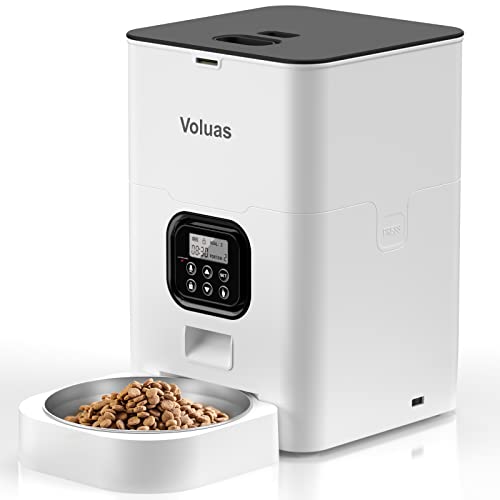
Once you have per-meal portions and times, enter them into the feeder. Start with the portion setting and confirm the feeder’s unit (grams, cups or portion counts). If the manual uses a portion count, run a test dispense into your scale and measure the output. Adjust the count until one dispense matches your target weight. Then set the schedule and run one full day before trusting it completely.
Step 7: Monitor and Adjust
Weigh your pet every one to two weeks for the first month. For dogs, a steady weight with a palpable waist and ribs that are easy to feel but not visible indicates a good match. For cats, look for a visible waist from above. If weight drifts by more than about 5 percent over several weeks, reduce or increase the portion by roughly 10 percent and recheck. Changes in stool, coat or energy also matter.
Factors That Shift the Number
- Age: Puppies and kittens need more energy per kg; seniors often need less.
- Activity: Working or high-exercise dogs may need 20 to 50 percent more than sedentary pets.
- Neutering: Spayed and neutered animals usually need fewer calories.
- Treats: Count treats toward the daily total. Many owners reduce meal portions to compensate.
- Weather and environment: Cold outdoor exposure can increase calorie needs modestly.
Common Mistakes
- Using the bag’s maximum feeding guide without adjusting for body condition.
- Assuming a scoop equals a fixed weight. Kibble density varies between brands.
- Forgetting that a feeder’s “portion” may be a unit of volume, not weight.
- Ignoring treats and table scraps, which can add a large share of daily calories.
- Changing food brands without recalculating, since kcal per kg varies widely.
- Leaving the feeder unchecked for weeks. Check that the hopper is not jammed or dispensing unevenly.
Tips for Accurate Dispensing
- Weigh one full day of food by hand and compare it to the feeder’s daily total.
- Keep the feeder’s hopper dry and clean, since moisture changes how kibble flows.
- Re-test the portion after switching bags or refilling with a different lot.
- Write the settings in a notebook so anyone pet-sitting can match them.
Recommended gear
A digital kitchen scale is the most useful accessory for verifying kibble weight before you program a portion count. Look for one that reads in one-gram steps and has a tare function so you can weigh the bowl first. Search: View on Amazon
A stainless or ceramic bowl keeps the feeder’s dispensing area clean and makes it easier to see what has been served. Search: View on Amazon
A pet-safe hopper cleaning brush helps prevent kibble dust and residue from clogging the dispensing mechanism over time. Search: View on Amazon
If you are comparing feeder models, the guides on Voluas Automatic Pet Feeder Portion Size Chart: How to Set Portions (2026) and Automatic Pet Feeders: Timers, Portions and Backup Power walk through how different units measure output. For programming specifics, see Pitpet Automatic Pet Feeder Manual: Setup, Programming and Troubleshooting Steps and Wopet Automatic Pet Feeder Setup: 7 Best Picks Compared (2026).
FAQ
Can I use the portion chart printed on the food bag instead?
Yes, as a starting point. Bag guidelines are general, so adjust based on your pet’s weight trend and body condition over several weeks.
How do I convert a feeder’s portion count to grams?
Dispense one portion into a scale, record the weight, and repeat a few times to average it. Multiply that weight by the number of portions you want per meal.
How often should I recalculate the portion?
Recheck every three to six months, and whenever your pet’s age, activity, neuter status or food brand changes.
Why does my pet still seem hungry on the feeder schedule?
Possible causes include underestimated calorie needs, a portion set too low, or a dispensing problem. Verify the actual output on a scale and talk to your veterinarian if weight is dropping.
Is it safe to split one meal into several small servings?
For most healthy pets, yes. Spreading meals can reduce begging and rapid eating. Ask your vet first if your pet is at risk of bloat or has a medical condition.
Do wet and dry food need different portion settings?
Yes. Wet food has far fewer calories per gram than dry kibble, so calculate from the can’s kcal-per-kg listing rather than reusing dry-food grams.
What if the feeder jams or dispenses unevenly?
Clean the hopper, check for kibble dust, and confirm the food size matches the feeder’s specifications. Most manufacturers list the compatible kibble size in the manual.
Conclusion
Start from a calculated daily calorie target, convert it to grams using your food’s kcal per kilogram, and split it into consistent meals. Verify the feeder’s actual output on a scale before relying on it. Then monitor your pet’s weight and body condition for several weeks and adjust in small steps. Consult your veterinarian for any puppy, kitten, senior or medical case.
Related reading
- Voluas Automatic Pet Feeder Portion Size Chart: How to Set Portions (2026)
- Pitpet Automatic Pet Feeder Portion Size: 8 Best Picks Compared
- Andoll Home Automatic Pet Feeder Portion Size: 8 Best Picks Compared
Ready to choose one?
About Ethan Brooks
Ethan Brooks is part of our editorial team and reviews and edits our everyday pet gear guides, checking product details against manufacturer specifications and owner feedback.