By Claire Whitaker
Retractable mesh gates give you a way to block extra-wide doors, archways, stair landings, and other openings where a standard swing gate will not fit. They mount with hardware, which makes them more secure than a pressure gate, but that also means you need to fasten the brackets properly, usually into wall studs. This guide walks you through how they work, how to mount them, and how they compare to pressure-mounted and hardware-mounted gates.
The short answer
A retractable mesh gate is a mesh panel that extends from a rolled cassette and locks into a receiver on the opposite side of the opening. Because the mesh is flexible, it can span wider and more irregular openings than a rigid gate. The gate must be fixed to the wall with the provided hardware, and the manufacturer’s instructions will tell you whether the brackets can go into wood, metal, drywall, or masonry and how to position them. Many retractable models are suitable for doorways, hallways, and some stair locations, but only use one on stairs when the product is clearly approved for that use.
How each gate type works
Retractable mesh gates
Retractable mesh gates use a spring-loaded fabric mesh that pulls out of a housing mounted on one side of the opening. You pull the mesh across and hook it into a wall-mounted receiver on the other side. When you release the lock or pull the handle, the mesh rolls back into the housing. The mesh fabric is usually a woven polyester or nylon with a metal or plastic bar at the leading edge.
The design means the gate package is compact when not in use, and it can cover openings that are too wide for a rigid swing gate. Because the mesh offers some flex, it is not designed as a climb-proof barrier on its own; combine it with supervision and training for pets that climb. Mounting requires screws and brackets, so you need to follow the included instructions to attach the housing and receiver securely.
Pressure-mounted gates
Pressure-mounted gates are held in place by tension between two surfaces, such as the sides of a door frame. They install without tools and are convenient for temporary use between rooms. The tension force comes from adjustable locking bars or a spring-loaded mechanism that presses against the frame.
Pressure gates are generally recommended for use in doorways and hallways and are not meant for the top of stairs because an active pet or child can knock them loose. The exact width range and installation order are described on the product’s spec sheet and instruction sheet, so measure your opening carefully before buying.
Hardware-mounted gates
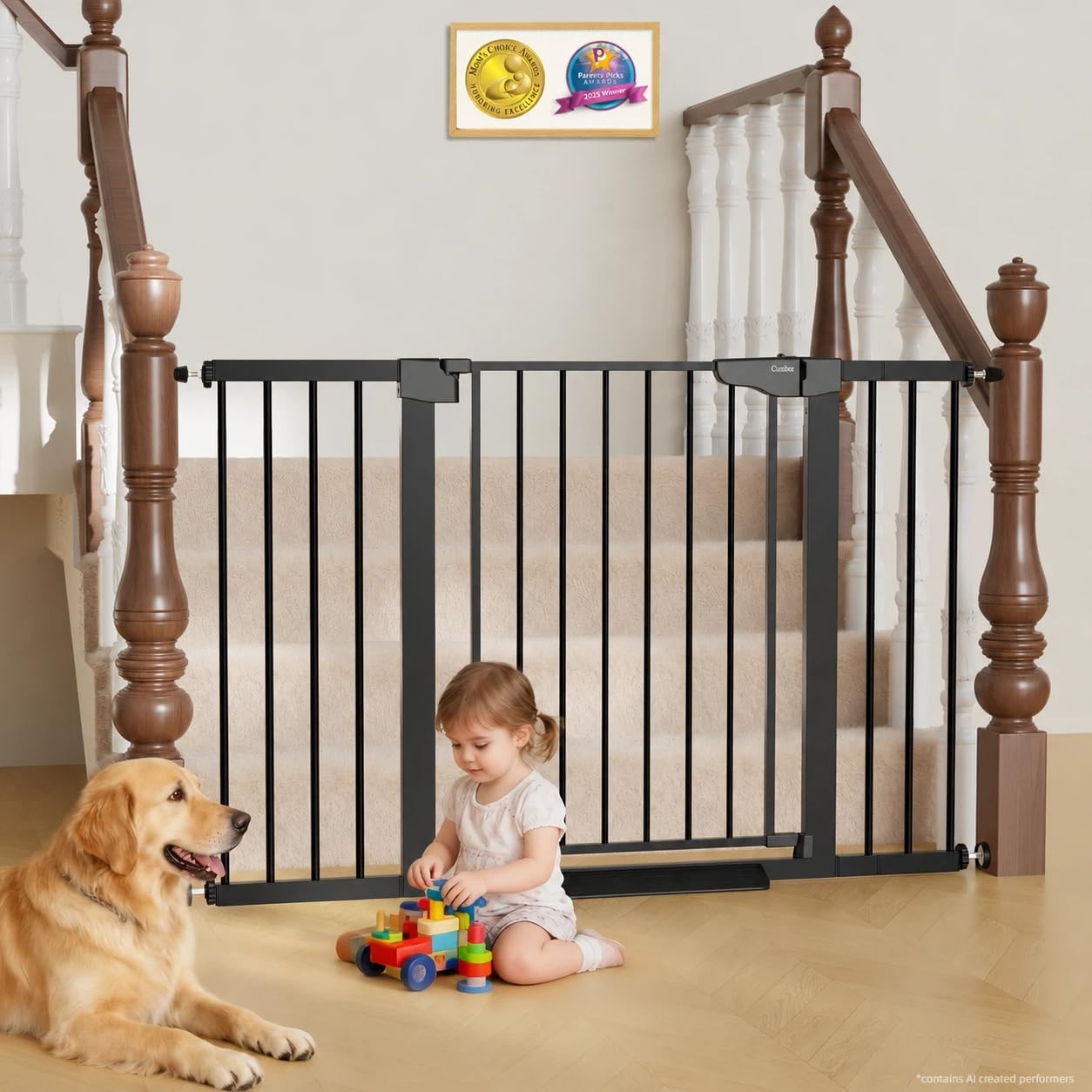
Rigid hardware gates are attached directly to a wall, door frame, or banister with screws rather than held in place by pressure. They usually have a swinging panel or a two-panel fold design. Because the screws carry the load, they tend to be sturdier than pressure gates and are more often approved for stairs, including the top of the stairs.
The trade-off is that they need drilling, and they generally fit a limited width range. If your opening is wider than the gate’s swing panel, a retractable mesh gate is often the practical alternative.
Side-by-side comparison
| Criteria | Retractable mesh gate | Pressure-mounted gate | Hardware-mounted gate |
|---|---|---|---|
| Opening width | Spans very wide and unusual openings; check the product’s size range | Best for standard doorways and some hallways | Limited by the swing panel width |
| Mounting | Screwed into wall studs or approved surfaces | No screws; held by tension | Screwed into frame, wall, or banister |
| Stability | Firm when properly mounted; mesh can flex under pressure | Good for light use but can shift | Most rigid of the three |
| Stair use | Only if the manufacturer approves it | Not for top-of-stair use | Often approved; confirm with instructions |
| Maintenance | Wipe mesh clean and check hardware | Occasional retightening | Check screws and hinges periodically |
When a retractable mesh gate is the better choice
Choose a retractable mesh gate when your opening is unusually wide, angled, or shaped in a way that a rigid panel cannot cover. They work well across open-plan thresholds, archways without doors, and the gap between a hallway and a living room. Because the mesh rolls away into a slim housing, it also suits spaces where you want the gate out of sight when it is not in use.
These gates are also practical if you need a barrier that can come down quickly. You can retract the mesh to let people and pets pass freely, then extend and lock it again when you need containment. For a closer look at the product type, see the retractable gates overview.
When the other gate types make more sense
Pressure-mounted gate
A pressure-mounted gate makes sense for temporary setups, rented homes, or situations where you cannot drill into the walls. It performs well in standard doorways and in rooms you want to keep off-limits for short periods. It is also a simpler gate to move from one opening to another. Be sure to follow the manufacturer’s width and frame requirements, and never place a pressure gate at the top of the stairs.
Hardware-mounted gate
A rigid hardware-mounted gate is a stronger choice for permanent barriers, especially for large dogs, strong chewers, or households with both children and pets. These gates feel more like a real door, and their swings can be anchored to a wall or banister in a way that leaves no flexible surface to flex or climb. If you have a traditional doorway and want a barrier that is built to last, a hardware-mounted gate is often the better fit. For a full look at the available styles, visit the pet gates and containment guide.
Mounting into studs and following instructions
Most retractable mesh gates are supplied with mounting brackets, screws, and sometimes an alignment template. The instructions will ask you to position the housing and receiver at a specific height and distance from the floor. The critical step is anchoring into a stud or the wall framing behind the surface.
Use a stud finder to locate the framing and mark the screw holes. Drill pilot holes as instructed so the screws go in straight without cracking the wall. If a screw hole lines up with a gap between studs, do not move the gate by eye; read the instructions to see whether you should shift the gate slightly or use the hardware meant for your particular wall construction.
Mounting on drywall alone is not a secure option for a gate that will take pressure from a pet. If your walls have metal framing, tile, or another tricky surface, contact the manufacturer for guidance before drilling. Always follow the instructions that came with your gate; the bracket direction and height matter for the lock to catch reliably.
Locking, chewing, climbing, and stairs
Locking mechanisms
Retractable gates typically use a latch on the receiver that clicks when the mesh bar is pushed in. Good designs have an easy-for-adults, hard-for-pets release, such as a sliding button you press while pulling, or a handle you squeeze. Some models use a two-step process that keeps animals from pawing or nosing the mechanism open.
Whatever the type, read the instructions to learn how the latch engages and disengages, and test it with your pet nearby. If you have a child, follow the manufacturer’s safety warnings and look for the product’s age guidance.
Chewing
Dogs, and occasionally cats, may chew on the fabric mesh. A hole in the mesh weakens the barrier and creates pieces that could be swallowed. If your pet mouths the gate, keep an eye on the mesh edges and do not assume the material is chew-proof; most mesh is not.
If you see chewing, redirect your pet to an appropriate chew toy. If you suspect your pet has swallowed any mesh material, contact your veterinarian at once, or call an animal poison control line if that is how your vet’s office directs after-hours emergencies.
Climbing
Climbing is a real concern with any mesh gate. Flexible mesh gives a climbing pet toeholds, and a determined animal may scale it. If your dog or cat is a climber, a retractable gate may not be the right barrier at the top of stairs.
You can reduce the risk by choosing a model with fine mesh openings, keeping furniture away from the gate, and supervising until you are confident the pet respects it. If the pet repeatedly climbs, switch to a rigid hardware-mounted gate instead.
Stair use
The key rule for stairs is to use a gate only where the manufacturer approves it. Some retractable gates are approved for top-of-stair use; others are not. Never install a pressure gate at the top of the stairs, and make sure any gate at the bottom of the stairs sits close to the floor so a pet cannot squeeze underneath.
For the top of the stairs, mount the gate on the wall and follow the manufacturer’s instructions precisely. Check the gate’s opening direction and whether the release faces away from the stairs so a child or pet cannot open it from the stair side. If the manufacturer does not say the product is for stair use, choose a hardware-mounted gate that does.
Upkeep and long-term ownership
With routine care, retractable mesh gates hold up well over time. Wipe the mesh with a damp cloth and a mild cleaner when it collects dust or pet hair, and let it dry before retracting it. This prevents the fabric from developing an odor inside the cassette.
Periodically check the screws, brackets, and latch for looseness and retighten as needed. Keep the rolling mechanism free of hair and debris, and follow the manufacturer’s cleaning recommendations for the housing material. If a screw becomes loose more than once, inspect the mounting location; the wall may need a different fastener or a different gate type.
Protect the gate from prolonged direct sun when practical, since intense sunlight can weaken the mesh over time. If the gate spans an opening you only sometimes need to block, many models let you pull the mesh only as far as required, which reduces wear on the fabric. For pets that are strong chewers or boisterous at barriers, a more rigid gate may serve you better for the long run, even if it takes up more space.
Top Picks to Compare
If you would rather start from a short list, these are popular options on Amazon for this search. Check each listing’s details, size and current price before you buy.


FAQ
Can a retractable mesh gate be used at the top of the stairs?
Only if the manufacturer’s instructions explicitly approve the product for stairway use. If the product does not say it is for stairs, do not use it at the top of the stairs. When approved, mount it securely into wall framing and make sure the latch release faces away from the stair side.
How do I mount a retractable gate into a stud?
Use a stud finder to locate the framing, mark the bracket holes, drill pilot holes as the instructions say, and drive the screws. If your studs do not line up, do not improvise; read the manual or contact the manufacturer for guidance on your wall type.
What should I do if my pet chews the mesh?
Remove the pet from the area, inspect the mesh, and check for missing pieces. If you think the pet swallowed any mesh, contact your veterinarian or an animal poison control line immediately. Then repair or replace the gate following the manufacturer’s instructions.
Are pressure gates ever safe for stairs?
Pressure gates are generally not recommended for the top of the stairs because they can be dislodged by weight or motion. Use a hardware-mounted gate that is approved for stair use, and follow the installation instructions exactly.
Retractable mesh gates solve a problem that rigid gates cannot handle: very wide or awkward openings. They require careful hardware mounting into studs, and they are not a fit for every pet or every location. Measure the opening, read the manufacturer’s instructions, and think about your pet’s habits around chewing and climbing before you choose. When installed correctly and used within its limitations, a retractable mesh gate can be a flexible and unobtrusive barrier in a busy household.
About Claire Whitaker
Claire Whitaker is part of our editorial team and reviews and edits our everyday pet gear guides, checking product details against manufacturer specifications and owner feedback.